Introduction: Why the Keyword “CourseTo” Keeps Appearing Online
In recent years, the internet has seen a growing number of articles discussing a term called CourseTo. At first glance, these articles often make CourseTo sound like a modern online learning platform, similar to popular education websites. Some blogs describe it as a place to take professional courses, while others mention certifications, skill development, or career growth.
However, when users attempt to locate an official CourseTo platform, they usually find no functional website, no enrollment system, and no clear evidence of an operating service. This gap between what is written and what actually exists has led many readers to question whether CourseTo is real or simply an idea created through blogging and SEO-driven content.
This article explores that question in depth. It examines what people are saying about CourseTo, why blogs are writing about it, how confusion spreads online, and what the verifiable truth actually is.
Understanding the Origin of the Term “CourseTo”
A Constructed, Not Historical, Term
The word CourseTo does not have a documented academic, linguistic, or historical origin. Unlike terms derived from Latin, Greek, or established educational theory, CourseTo appears to be a constructed keyword.
The structure of the word is simple:
- Course – referring to education or learning material
- To – suggesting direction, access, or movement
Combined, the phrase implies “a path to courses” or “access to courses.” This construction makes it sound legitimate, intuitive, and educational, even though it lacks institutional backing.
Why the Name Sounds Real
CourseTo follows a naming pattern commonly used by technology startups and platforms:
- Short
- Easy to pronounce
- Related to education
- Neutral and flexible
Because many legitimate platforms use similar naming conventions, readers naturally assume CourseTo must also be real.
What Blogs and Articles Claim About CourseTo
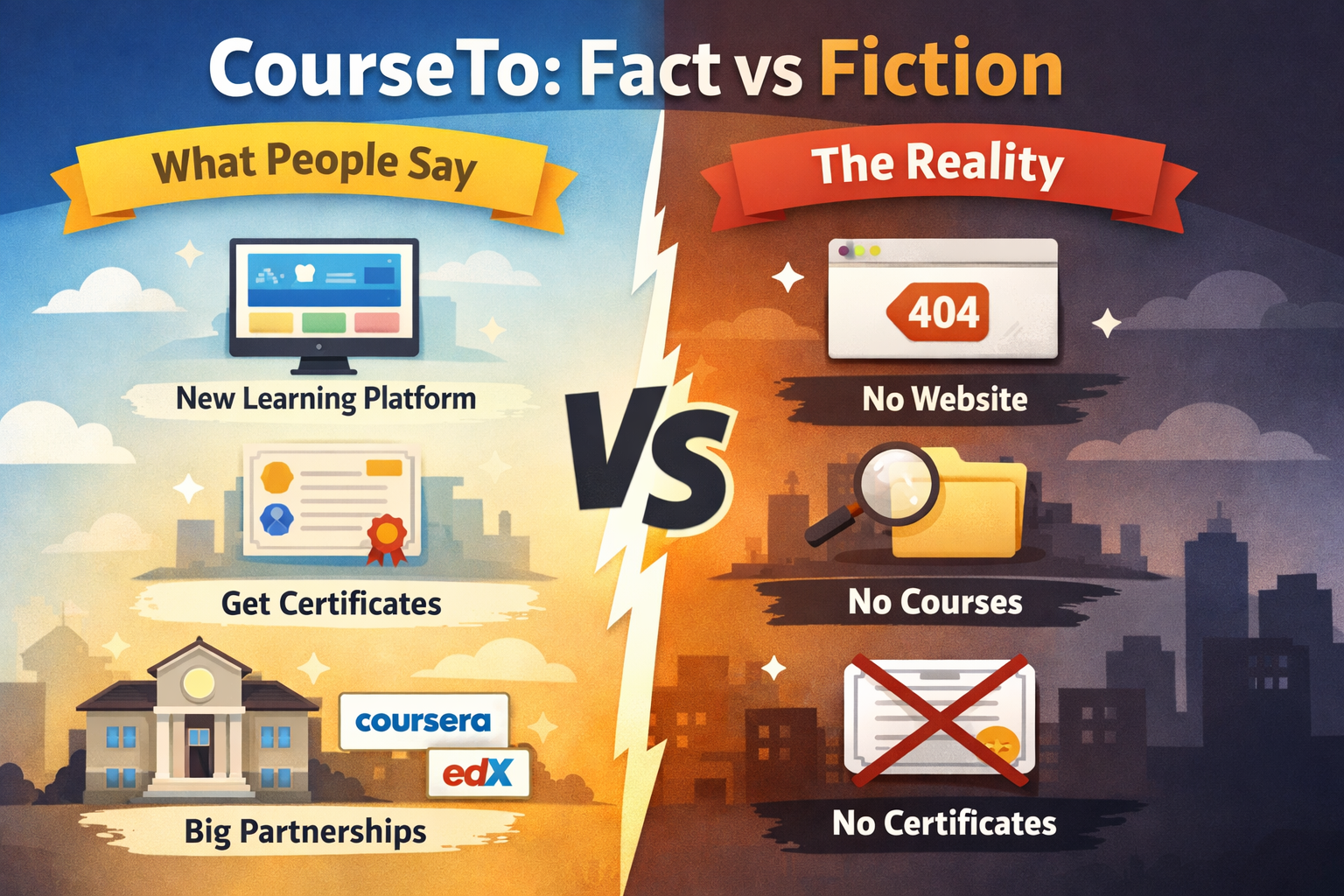
Across multiple websites, CourseTo has been described in ways that imply it is an actual service. Common claims include:
- CourseTo is an online learning platform
- CourseTo offers professional development courses
- CourseTo helps learners gain new skills
- CourseTo competes with major education platforms
- CourseTo provides certificates
Some articles even go further, presenting CourseTo as:
- A “new alternative” to established platforms
- A “hidden gem” for online education
- A platform that “aggregates top courses”
These claims are usually written confidently, with headings, comparisons, and summaries that mimic legitimate platform reviews.
The Critical Problem: Lack of Verifiable Evidence
No Official Platform
Despite widespread mentions, there is:
- No verified CourseTo homepage
- No confirmed company registration
- No visible learning management system
- No student dashboard or login portal
In contrast, real platforms leave behind a clear digital footprint—documentation, user interfaces, support pages, and public-facing infrastructure.
No Institutional or Industry Partnerships
Legitimate education platforms typically highlight:
- University partnerships
- Industry collaborations
- Instructor profiles
- Accreditation or credential frameworks
There is no public evidence that CourseTo has any such partnerships.
No Course Ownership or Certification Authority
Courses mentioned in “CourseTo” articles are almost always:
- Generic
- Not traceable to CourseTo itself
- Similar to content found on other platforms
This strongly suggests that CourseTo does not create or host original educational content.
Why People Confuse CourseTo With Real Platforms
Association by Language, Not Reality
One major reason for confusion is linguistic association. Articles often mention CourseTo alongside established platforms such as Coursera, edX, or Udemy.
When names appear together in text, readers subconsciously assume a relationship, even if none exists.
SEO-Driven Comparisons
Some blog posts include sections like:
- “CourseTo vs Coursera”
- “Is CourseTo better than other platforms?”
These comparisons are speculative and unsupported, but they create perceived legitimacy.
The Role of SEO and Content Farming in the CourseTo Narrative
Low-Competition Keyword Targeting
“CourseTo” appears to be a low-competition keyword, which makes it attractive to content creators trying to rank quickly in search engines.
Writers may:
- Assume the platform exists
- Fill content gaps with speculation
- Publish articles without verification
Once indexed, these articles reinforce each other, creating the illusion of legitimacy.
Content Recycling and Assumptions
Many CourseTo articles share similar structures, phrasing, and ideas, suggesting:
- Content rewriting
- AI-assisted content generation
- Copying without primary research
This results in multiple pages repeating the same unverified claims.
What Real Users Experience When Searching for CourseTo
People who search for CourseTo often report the following experiences:
- They cannot find an official website
- They encounter blog posts instead of platforms
- They find no way to enroll in courses
- They find no proof of certificates
- They find no contact or support information
This mismatch between expectation and reality leads users to question the credibility of the information they encountered.
Is CourseTo a Scam?
Important Distinction: Misrepresentation vs Fraud
Based on available evidence, CourseTo does not appear to be a scam in the traditional sense. There is no indication of:
- Payments being taken
- Fake certificates being sold
- Users being defrauded financially
However, there is a problem of misrepresentation through content.
The issue lies not in malicious intent, but in:
- Assumptions
- Poor fact-checking
- SEO-focused publishing without verification
CourseTo as a Concept Rather Than a Platform
The most accurate way to describe CourseTo is:
A conceptual or keyword-based term that exists in written content but not as an operational education service.
It functions more as:
- A blogging topic
- A theoretical idea
- A placeholder name
This explains why it appears in articles but not in reality.
Why Imaginary Platforms Appear So Often Online
The Pressure to Publish Quickly
Modern content ecosystems reward:
- Speed
- Volume
- Keyword coverage
This pressure sometimes results in articles being published before facts are verified.
AI and Automated Content Generation
With the rise of automated writing tools, it has become easier to generate plausible-sounding articles about entities that do not actually exist.
If one article mentions CourseTo, others may follow without checking sources.
The Responsibility of Educational Content Creators
Education is a trust-based field. Readers expect:
- Accuracy
- Transparency
- Verification
Publishing imaginary or speculative platform reviews can:
- Mislead learners
- Waste users’ time
- Reduce trust in online education content
Responsible content creation requires clear distinctions between:
- Real platforms
- Concepts
- Hypothetical ideas
How Readers Can Verify an Online Learning Platform
Before trusting claims about any platform, readers should check:
- Does the platform have an official website?
- Is there a visible course catalog?
- Can users enroll directly?
- Are instructors identified?
- Are certificates verifiable?
- Are there real user reviews outside blogs?
If these elements are missing, skepticism is justified.
CourseTo vs Established Learning Platforms
To clarify the difference, here is a reality-based comparison:
| Feature | Established Platforms | CourseTo |
|---|---|---|
| Official website | Yes | No verified site |
| Course hosting | Yes | No evidence |
| Certificates | Yes | No evidence |
| Partnerships | Yes | None found |
| Student accounts | Yes | None found |
This comparison highlights that CourseTo does not meet the criteria of a functioning platform.
Why the CourseTo Myth Persists
Despite the lack of evidence, CourseTo continues to appear in content because:
- Articles reference each other
- Readers do not always verify claims
- Search engines index content neutrally
- The name sounds believable
Over time, repetition creates perceived reality.
The Impact of Misinformation in Education Topics
Even unintentional misinformation can have consequences:
- Learners may delay real education
- Readers may distrust legitimate platforms
- Search results become cluttered with inaccuracies
This is why clarity and honesty are essential in education-related writing.
How Search Engines Treat Keywords Like CourseTo
Search engines do not automatically verify whether a platform exists in the real world. Instead, they evaluate content based on relevance, structure, internal consistency, and user engagement. If enough articles talk about a term like CourseTo, search engines may treat it as a valid topic—even if no real platform exists.
This explains why searches for CourseTo often return:
- Blog articles
- Explainer posts
- Comparisons
- Opinion pieces
Rather than an official website.
Search engines index content, not truth. This is a critical distinction that explains how imaginary or speculative entities can gain visibility online.
The Difference Between a “Search Term” and a “Service”
One of the biggest misunderstandings surrounding CourseTo is the assumption that:
“If something appears in search results, it must exist as a service.”
In reality, many search terms represent:
- Concepts
- Ideas
- Hypothetical services
- User curiosity
- Linguistic constructions
CourseTo fits into this category. It behaves like a search term, not a service.
A real service typically leaves behind:
- Legal records
- Corporate pages
- Product documentation
- Support systems
- User interfaces
CourseTo leaves behind articles, not infrastructure.
How Imaginary Platforms Gain Authority Over Time
Step 1: Initial Assumption
A writer assumes CourseTo is a platform and writes an article describing it.
Step 2: Indexing
Search engines index the article.
Step 3: Repetition
Other writers reference the indexed content without verification.
Step 4: Confirmation Bias
Readers see multiple articles and assume legitimacy.
Step 5: Perceived Authority
The term gains authority simply through repetition.
This process is not unique to CourseTo. It happens frequently in:
- Technology topics
- Finance
- Education
- Health-adjacent discussions
Why Education Topics Are Especially Vulnerable
Education content is particularly susceptible to this phenomenon because:
- Readers trust educational language
- Terms like “course,” “certificate,” and “learning” feel authoritative
- Many legitimate platforms exist, making imitation easier
- Readers often search passively rather than critically
As a result, an invented or misunderstood term can blend into the educational ecosystem without immediate scrutiny.
CourseTo as a Case Study in Content Assumptions
CourseTo serves as a valuable case study for understanding how:
- Assumptions become narratives
- Narratives become “facts”
- Facts are accepted without verification
The majority of articles discussing CourseTo do not cite:
- Official sources
- Primary documentation
- Platform-owned materials
Instead, they rely on:
- General language
- Comparisons
- Hypothetical benefits
This is a hallmark of assumption-based content.
Ethical Considerations for Bloggers and Publishers
Publishing content about non-existent platforms raises important ethical questions:
- Should writers verify platform existence before publishing?
- Should speculative content be clearly labeled?
- Should editors require source confirmation?
In education-related topics, the ethical bar should be higher because readers may make career or learning decisions based on what they read.
The Risk of Creating False Expectations
When readers believe it is real, they may:
- Delay enrolling in legitimate programs
- Waste time searching for access
- Distrust education platforms when expectations are unmet
Even without malicious intent, misinformation can have real consequences.
How Readers Can Protect Themselves From Similar Confusion
Readers can avoid confusion by following a simple verification checklist:
- Search for the platform’s official domain
- Look for a clear “About” or “Company” page
- Check for real course enrollment options
- Look for instructor profiles
- Verify certificate authenticity
- Check independent review platforms
If these elements are missing, the platform may not exist as described.
CourseTo vs Conceptual Educational Terms
Some terms exist only as concepts, such as:
- “Future-ready learning”
- “Smart education hubs”
- “Next-generation classrooms”
These are ideas, not platforms.
It aligns more closely with this category than with real services.
Why Clear Labeling Matters in Content
If an article presents it as:
- A concept → acceptable
- A keyword trend → acceptable
- A theoretical aggregator → acceptable
But presents it as:
- An operational platform
- A certificate provider
- A competitor to established platforms
Then it crosses into misinformation.
Clear labeling prevents confusion.
The Role of AI in Amplifying Platform Myths
AI-generated content can unintentionally amplify myths by:
- Filling gaps with plausible assumptions
- Replicating existing content patterns
- Rewriting unverified articles at scale
Without human fact-checking, AI can turn speculation into perceived consensus.
This makes human editorial oversight more important than ever.
Why CourseTo Still Has Search Value
Despite not being a real platform, It still has value as a topic because it:
- Reflects user curiosity
- Reveals SEO behavior patterns
- Demonstrates content ecosystem flaws
- Serves as an educational example
Writing truth-clarifying content about it is more valuable than repeating myths.
What Responsible Coverage of CourseTo Looks Like
Responsible articles should:
- Clearly state uncertainty
- Avoid definitive claims
- Focus on verification
- Explain why confusion exists
- Educate readers on critical evaluation
This article aims to do exactly that.
The Long-Term Impact of Corrective Content
When fact-based articles exist, they:
- Balance speculative content
- Help search engines understand context
- Protect readers from misinformation
- Improve overall content quality
Corrective content does not attack other writers—it simply restores clarity.
Read also Is Affiliate Marketing a Pyramid Scheme?